

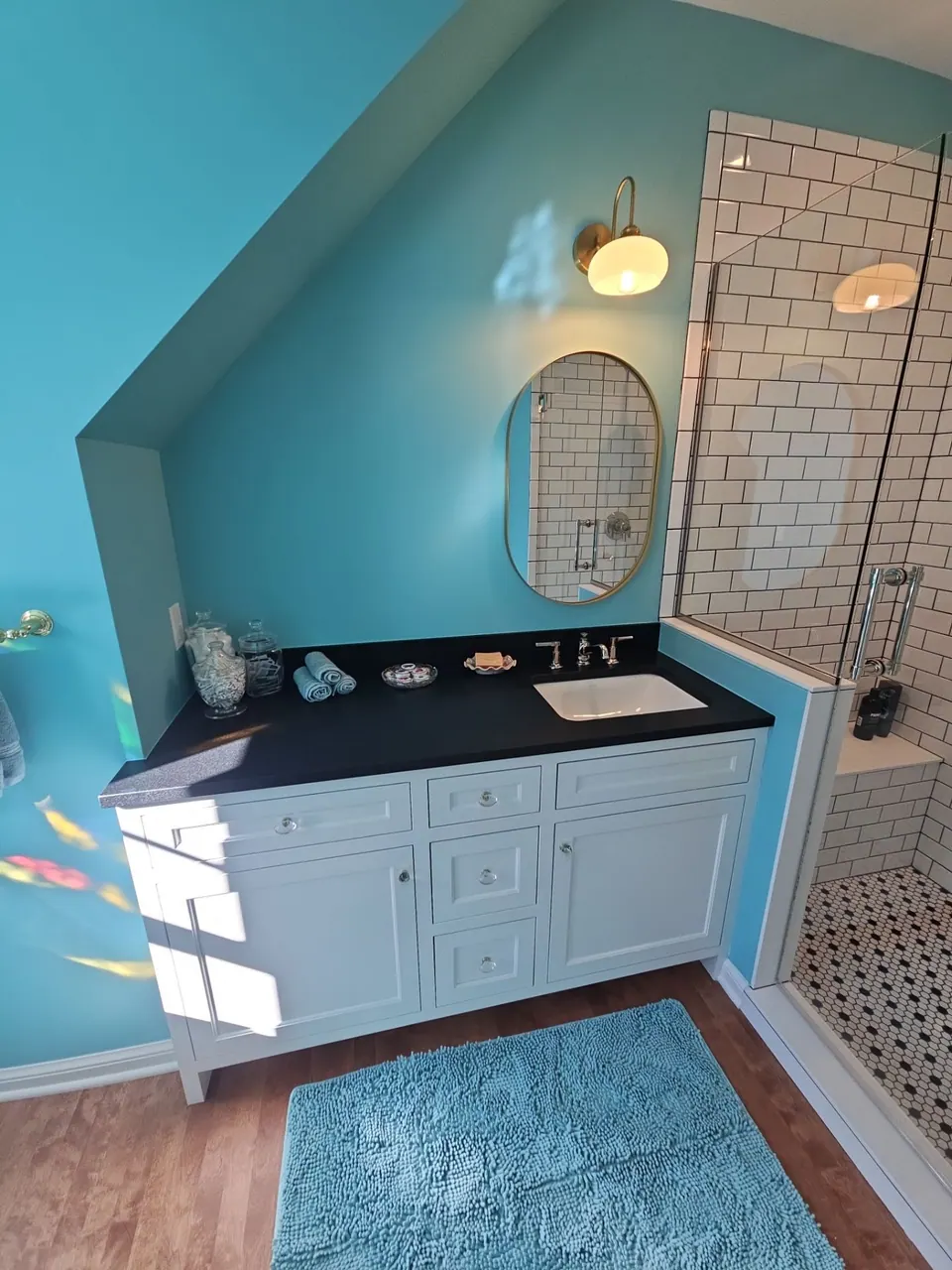
Which wall gets the color
The wall that works as an accent is the one your eye lands on when you walk in, and it is usually the one with the least going on. The wall behind the bed, the fireplace wall, the far wall of a dining room, the short wall at the end of a hallway. A wall full of windows and doors is a poor candidate because the color gets chopped into pieces. A vaulted room needs some thought about where the color stops at the ceiling angle. In bathrooms and laundry rooms, the vanity wall or the wall you face from the door is the natural pick. We walk the room with you and say which wall we would paint and why, and we will also say when a room does not want one.
Deep colors need a tinted primer and a third coat
Teal, navy, forest green, charcoal and brick red all have less white pigment in them, so they cover poorly on their own. Two coats over a white wall often looks streaky, with the roller pattern visible in the sheen. The fix is a primer tinted toward the finish color, then two finish coats, and sometimes a third on the brightest reds and yellows. We use an eggshell or matte on accent walls because higher sheen shows every roller lap in a dark color. In winter, dry indoor air makes these paints set fast and lap marks show more, so we roll the whole wall without stopping. In summer we give the coats more time. The wall in the photo is two finish coats over a tinted grey primer.
- Primer tinted toward the finish color
- Two finish coats, sometimes three on reds and yellows
- Eggshell or matte so the roller pattern does not show
Sharp corners where the accent meets the main wall
The inside corner is where an accent wall succeeds or fails. Drywall corners are never perfectly straight, so tape alone leaves a wandering line, and dark paint bleeding under tape onto a white wall is hard to fix. Our method is to paint the light wall first and let it cure, run a low-tack tape on the light side of the corner, seal the tape edge with a thin coat of the light wall color so any bleed is invisible, then paint the accent color and pull the tape while the last coat is still slightly wet. At the ceiling we cut by brush. It sounds fussy. It is also the reason the corner looks like a knife edge instead of a saw blade.
When we would talk you out of it
- A room with several small walls and no clear focal wall. The accent gets lost and the room feels chopped up. Painting the whole room a soft version of the color usually works better.
- A wall you are planning to hang a large TV or gallery across. The color disappears behind what you hang. Put the accent on the wall you actually see.
- Renters who need the wall back to white at move-out. A deep color takes primer and two coats to cover. If you still want it, we will tell you what the reversal costs before you commit.
What you get
- Help picking the wall and the shade, sampled on the wall first
- Tinted primer so deep colors cover in two coats
- Matte or eggshell finish that hides roller pattern
- Corners sealed and cut so the color line is straight
- Ceiling line brushed, not taped
- Done in a day for most single walls
How it goes
- 1
Pick the wall and sample the color
We walk the room with you and paint a large sample of two or three shades on the actual wall. Deep colors shift a lot between the chip and the wall.
- 2
Prep and tinted primer
Holes filled, wall sanded and cleaned, corners taped on the light side and sealed. Then a primer tinted toward the finish color so the accent covers in two coats.
- 3
Two finish coats, wet edge kept
Each coat rolled across the whole wall in one pass so no lap marks show in the sheen. Reds and yellows may need a third coat, which we tell you up front.
- 4
Pull tape, cut the ceiling, walk it
Tape comes off while the last coat is slightly wet for a clean edge. Ceiling line is finished by brush. We check the corners with you under lamp light.
How much does an accent wall cost to paint?
Most single accent walls are quoted from a photo and finished in a day. The price moves with the wall size, the height, and the color. A deep or bright color that needs a tinted primer and three coats takes longer than a mid-tone that covers in two. A vaulted wall that needs staging costs more than an eight-foot one. If the rest of the room is being painted at the same time, the accent wall is a small add-on because the room is already masked and we are already there. As a standalone visit it carries the setup time. The estimate is free and spells out the coat count.
- Wall size and ceiling height
- How deep or bright the color is (primer and coat count)
- Done with a full-room repaint or as a standalone visit
- Vaulted or angled walls that need staging
- Trim, outlets and fixtures to work around
Questions we get on the phoneStraight answers.
Which wall should be the accent wall?
The wall your eye goes to first when you walk in, usually the one behind the bed, the fireplace wall, or the far wall you face from the door. Pick the wall with the fewest windows and doors so the color reads as one shape. If no wall is an obvious pick, the room may not want an accent wall at all.
Do accent walls need primer?
Deep and bright colors do. Without a tinted primer they take three or four coats to stop looking streaky, and the roller pattern shows through the sheen. Light and mid-tone accents can often go straight on in two coats. We tell you which your color needs when we sample it on the wall.
Can an accent wall be painted in one day?
Most can. Prep, primer and two coats fit in a day when the wall is a normal height and the color is not one of the stubborn reds or yellows. Dry winter air speeds the recoat; a humid July day can push the second coat to the next morning. We give you the timing when we quote.
How do you get a straight line in the corner?
Paint the light wall first and let it cure, tape on the light side of the corner, seal the tape edge with the light color so any bleed is invisible, then paint the dark color and pull the tape while the last coat is still slightly wet. The ceiling line is cut by brush.
Related
Where we do this work
Accent walls across Independence, Medina, Corcoran, Orono, Wayzata, Plymouth, Maple Grove and Minnetonka, and the rest of the west metro and Central Minnesota. See the full service area.